
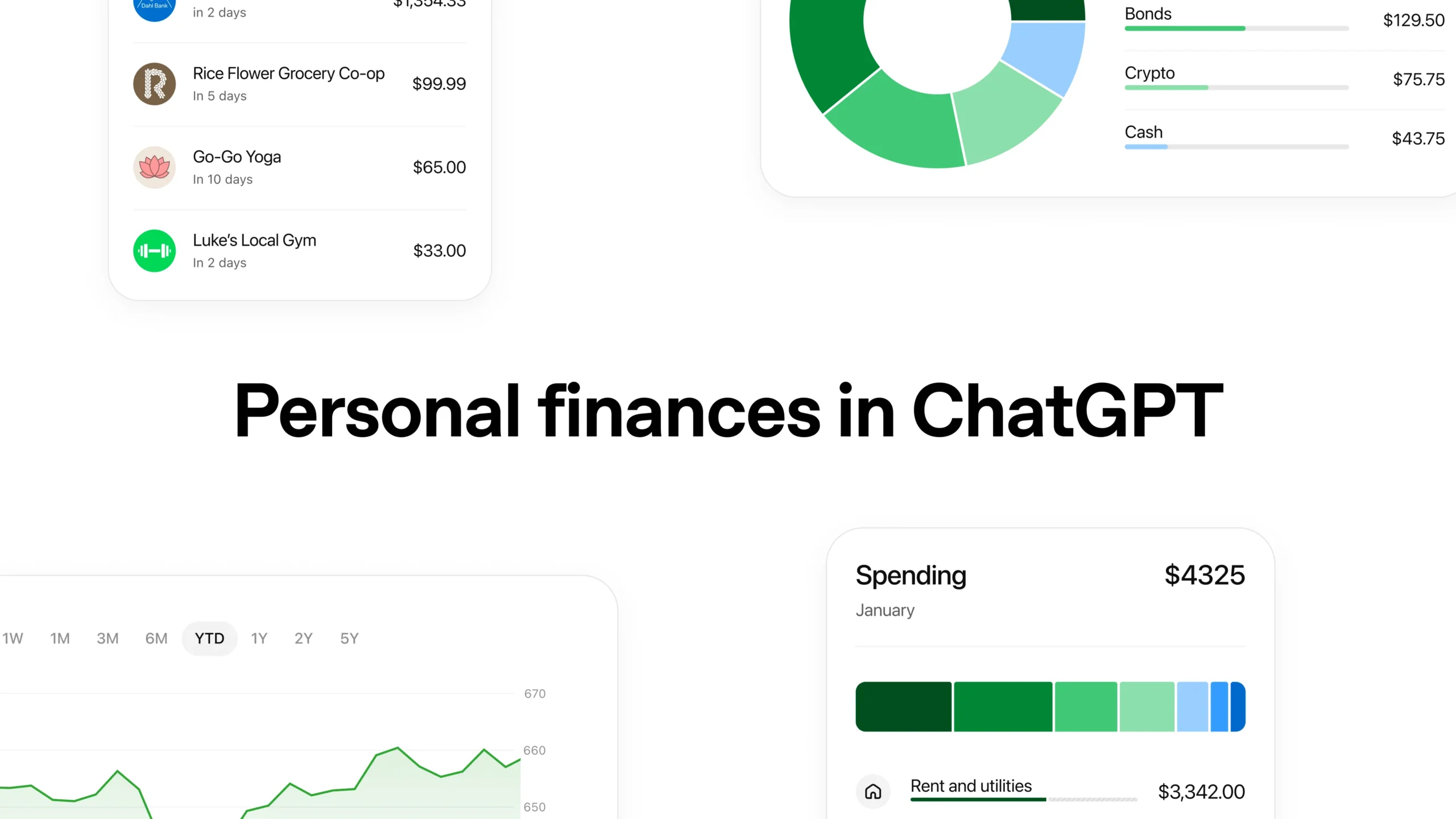
OpenAI has officially entered the world of personal finance in a very big way. The company has launched a new ChatGPT finance tool that allows users to connect their bank accounts, credit cards, and investment accounts directly to ChatGPT.
This means ChatGPT is no longer just a chatbot for writing emails, answering questions, or helping with homework. It can now help users track spending, manage subscriptions, understand investments, plan for future goals, and even prepare for buying a house.
For now, the feature is only available to ChatGPT Pro users in the United States. These are users paying $200 monthly for the premium version of ChatGPT. OpenAI says it plans to improve the feature with feedback before releasing it to Plus users and eventually more people around the world.
The move shows how fast AI is becoming part of everyday life. People already use ChatGPT for work, business, school, coding, health questions, and relationship advice. Now, OpenAI wants people to use it for money decisions too.
What Exactly Is the New ChatGPT Finance Tool?
The new ChatGPT finance tool is a system that lets users safely connect their financial accounts to ChatGPT. Once connected, ChatGPT can see important financial information like spending habits, balances, subscriptions, investments, bills, and upcoming payments.
After connecting an account, users get a dashboard inside ChatGPT that gives them a full picture of their financial life. Instead of opening different banking apps, investment apps, or budgeting tools, users can see everything in one place.
The system is powered by Plaid, a popular financial connection service used by many fintech companies worldwide. Plaid already works with over 12,000 financial institutions, including Chase, Fidelity, Schwab, Robinhood, American Express, and Capital One.
OpenAI says users can simply go to the “Finances” section inside ChatGPT and click “Get Started.” Another option is typing “@Finances, connect my accounts” directly inside a chat conversation.
After that, ChatGPT guides users through the account linking process.
What Can Users Ask ChatGPT About Their Money?
This is where things become very interesting. Once financial accounts are connected, users can ask ChatGPT questions in simple everyday language.
For example, someone can ask:
- “Why have I been spending more money recently?”
- “What subscriptions am I still paying for?”
- “Can I afford to buy a house in the next five years?”
- “What was the total cost of my recent vacation?”
- “Can I take a lower paying job and still survive financially?”
Instead of giving generic advice, ChatGPT can now answer based on the user’s real financial data.
This changes the experience completely. Traditional budgeting apps mostly show charts and numbers. ChatGPT goes further by explaining what those numbers actually mean in simple words.
For example, it may notice that a user suddenly started spending more money on food delivery or transportation. It may also point out subscriptions the user forgot about months ago.
OpenAI says the feature is designed to feel more like speaking with a personal finance assistant.
ChatGPT Is Now Moving Into Financial Planning
One major part of the launch is long term financial planning. OpenAI says ChatGPT can now help users create financial goals and realistic plans.
For example, if someone wants to buy a home, ChatGPT can look at income, savings, expenses, debts, and investments to estimate how realistic the goal is. It can also suggest areas where spending can be reduced.
This is one of the biggest shifts in the AI industry right now. AI tools are no longer just answering questions. They are slowly becoming decision making assistants.
OpenAI says more than 200 million users already ask ChatGPT finance related questions every month. This likely pushed the company to build deeper finance features.
The company also mentioned that GPT 5.5, its newer AI model, is better at understanding financial context and reasoning. According to OpenAI, this makes it better at giving smarter and more useful financial answers.
OpenAI Recently Bought a Finance Startup
Interestingly, this launch happened shortly after OpenAI acquired a startup called Hiro Finance in April 2026.
Hiro described itself as an “AI personal CFO” company. The startup focused on helping people understand and manage their finances using artificial intelligence.
Reports say OpenAI absorbed the entire Hiro team into the company. OpenAI later confirmed that Hiro’s finance expertise helped in building the new ChatGPT finance tool.
This acquisition now makes a lot more sense. OpenAI clearly wants ChatGPT to become deeply involved in personal finance and money management.
What Information Can ChatGPT See?
According to OpenAI, ChatGPT can access balances, transactions, investments, liabilities, subscriptions, and spending patterns.
However, the company says the chatbot cannot move money, transfer funds, or see full account numbers. This is likely an important security step because many users are already worried about privacy.
OpenAI also says users remain in control of their data. If someone disconnects their financial accounts, the synced data is deleted from ChatGPT within 30 days.
Users can also delete what OpenAI calls “financial memories.” These are details ChatGPT remembers about a user’s financial life so future answers can feel more personal.
For example, ChatGPT may remember that a user is saving for a house or paying back a family loan. Users can remove these memories manually if they want.
Temporary chats also do not connect with financial accounts.
Privacy Concerns Are Already Growing
Even though the feature sounds powerful, many people are already asking serious questions about privacy and security.
Money is one of the most sensitive parts of a person’s life. Some users may not feel comfortable allowing an AI chatbot to study their spending habits, debts, or investments.
Others worry about what could happen if financial data is exposed during a security breach.
This concern is not surprising. In recent years, people have become more careful about how tech companies handle personal data.
OpenAI says it worked carefully with finance experts while building the product. The company also says Plaid handles the connection system, which is already widely trusted in the fintech industry.
Still, experts believe users should be cautious and avoid depending completely on AI for financial decisions.
Can ChatGPT Replace Financial Advisers?
At least for now, the answer is no.
While ChatGPT can explain financial information and help users understand their money better, it still has limitations. Financial advisers often consider deeper human situations that AI may miss.
Recent comparisons between ChatGPT and certified financial advisers showed that ChatGPT can provide useful general answers, but sometimes misses important details or gives advice that is too broad.
OpenAI itself admitted this. The company said ChatGPT is not a replacement for professional financial advice.
That said, many people may still find the tool useful because it makes financial information easier to understand. A lot of people struggle with budgeting apps, investment terms, and financial planning. ChatGPT simplifies these conversations in a more natural way.
Also Read
X Launches New History Tab for Likes, Videos, Articles and Bookmarks
What This Means for the Future of AI
This launch is another sign that AI companies are entering highly personal parts of people’s lives. First, AI tools helped with writing and productivity. Then they moved into health, relationships, and education. Now they are entering banking and finance.
The bigger goal is becoming clearer. Companies like OpenAI want AI assistants to become daily life companions that help users with almost everything. For now, only US Pro users can test the feature. But if OpenAI gets positive feedback, it may not take long before millions more users gain access.
One thing is certain, the line between artificial intelligence and personal life is becoming smaller every single year.
